A legal-intake demo modeled to reclaim 600 senior hours
A demo-tested intake workflow on synthetic data, with conflict clearance before engagement and a modeled $74,000 Year-1 scenario. No client outcome is claimed.
No client outcome is claimed. The figure below is a modeled scenario; inspect the assumptions before applying it to your business.
- Modeled Year-1 savings
- $74,000
- Modeled senior capacity
- ~600 hrs/yr
- Human gate
- Conflict check
- Test data
- Synthetic
Demo-tested system. Synthetic data. Modeled savings. Conflict clearance, legal judgment, and final approval remain with a lawyer. No client outcome is claimed.
The most expensive people doing the most repetitive work
A modeled boutique-firm scenario puts new-client intake on partner and senior-associate time. Someone checks conflicts, sends the engagement letter after clearance, collects documents, keys details into the practice-management system, opens the matter, structures the file, and chases missing items.
It was the same sequence every time. And it was being done by the most expensive people in the building, in between the work clients actually pay for. The firm wasn’t short on demand, it was short on the hours its experts could spend on real legal work instead of moving information from an email into a form.
What we measured
Professional-services intake is unusually measurable because the people doing it bill by the hour, so the opportunity cost is explicit:
- Senior capacity: partner and associate time per new matter, counted once. Use loaded labor cost when capacity is removed, or realized contribution from billable redeployment when that output is measured, never both.
- Errors & delay: matters that stalled because a document was missing and nobody had chased it.
Across a typical firm’s intake volume, the baseline comes to roughly $74,000/year, dominated by senior time spent on a clerical sequence.
Compliance was a design input, not an afterthought. In a legal context the automation had to respect conflict checks, retention rules, and confidentiality. We built on the firm’s own systems, kept data inside their controlled environment, and left every privileged decision with a human. The machine moves information; lawyers make judgments.
What we built
The demo models an intake-to-matter pipeline with conflict clearance as the first hard gate:
- Conflict search prepared for human approval before engagement or substantive document collection begins.
- Engagement letter generated after clearance, with the right details merged in and ready for lawyer approval and e-signature.
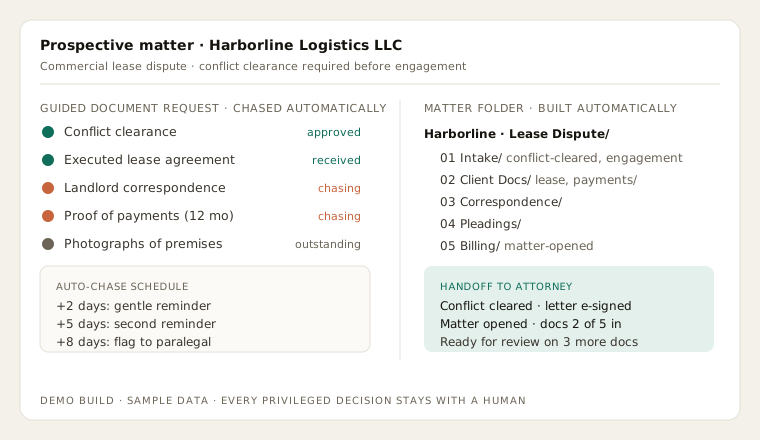
- A guided document request that tells the client exactly what’s needed and in what format, then chases politely on a schedule until everything’s in, no partner involved.
- Matter opened and file structured after clearance and engagement, with details captured once instead of re-keyed.
- A clean handoff to the responsible lawyer, with outstanding documents and every approval visible.
Live in ten days, run alongside the manual process until the partners trusted it.
The result
The modeled scenario assumes roughly 600 hours of senior capacity can be reclaimed across a year. A real engagement would count that value only after showing the hours were removed or redeployed to measurable output. Reminder completion, intake cycle time, and human review time would be measured separately.
The $74,000 figure is a modeled scenario, not a client result. It requires a real firm to substantiate matter volume, minutes per step, approved contribution value, completion rate, and residual review time before it can become a projection used for pricing.
See it run
We built the intake-to-matter pipeline and ran it on a sample new client. The engagement letter goes out for e-signature, the document request chases itself, the matter folder is created, and a handoff checklist tells the attorney exactly what is left, with every privileged decision still made by a human.
Why it travels
Accountants, agencies, consultancies, clinics: any professional-services firm runs a version of this, a high-value expert spending hours on a repeatable intake-and-document sequence. The pipeline we built generalizes cleanly to those, which is exactly the kind of reusable asset every See.ke build is meant to produce.
If your most expensive people are doing your most repetitive work, book a free Savings Audit. We’ll measure it precisely, and you keep the number even if you never hire us.